
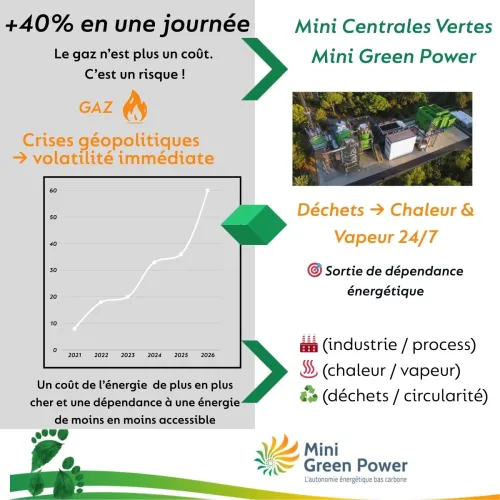
Geopolitical crises have a formidable capacity: they can cause gas prices to fluctuate within hours.
For:
Gas volatility is no longer a cyclical issue: it is a structural risk.
Key points:
Repeated crises: 2009, 2018, 2022... and today
The current sharp rise is neither the first nor the last. Gas shocks have become more frequent and closer together:
Operational conclusion: crises are no longer exceptional. They follow each other more quickly, spread more widely via the global LNG market, and make the gas bill structurally exposed to factors beyond our control.
What happened on March 2, 2026:
This sequence illustrates a typical mechanism: a geopolitical event in a critical energy zone → rapid price increase.
Key elements reported in the news:
For an industry that needs continuous heat and/or steam, the challenge is to control risk before seeking marginal optimization.
A robust alternative meets four criteria:
This is the heart of energy independence: securing a vital part of the mix (the one that keeps the business running), then capturing the ROI.
A globalized market, and therefore exposed to shocks
Gas (and even more so liquefied natural gas—LNG) depends on a complex value chain: production, liquefaction, maritime transport, regasification, storage, networks. Each link can become a point of fragility.
As soon as an event threatens a corridor, a production area, critical infrastructure, or a strategic maritime route, the markets reprice the risk. Prices no longer evolve solely according to “normal” supply and demand: they incorporate an immediate risk premium.
Sustained volatility, not a blip
Since 2022, Europe has experienced a regime change: increased volatility, extreme episodes, and uncertainty about the stability of supplies. Even when tensions ease, the market remains sensitive.
For economic players, the key issue is not the “average price”: it is unpredictability.
Operators, service providers, and local authorities working in the waste sector are facing simultaneous pressure from:
In this context, having a local, robust, and controllable recovery channel is a game-changer: waste becomes a resource, not just a burden.
2. 24/7 manufacturers:
Heat and steam are at the heart of the processIn many sectors (agri-industry, materials, chemicals, paper, thermal processes, drying), steam and heat are essential:
When the energy source becomes volatile or exposed to disruptions, the risk is not only financial. It becomes operational: production, contracts, deadlines, safety.
3. Local authorities: managing the dual constraint of energy and waste
Local authorities have two responsibilities:
However, these two issues can be resolved together if we think in terms of a local loop: recovering some of the waste in a short cycle to produce useful and controllable energy for the benefit of the region.
Energy independence does not mean producing everything “self-sufficiently.” It means reducing exposure to external shocks by securing a vital part of the mix.
In concrete terms, this makes it possible to:
Once this basis is secured, the ROI becomes apparent: reduced exposure to volatility, optimized costs, and budget visibility.
If the goal is a safe, sustainable, and constant-price alternative, the most robust path is to replace a portion of gas with energy that does not depend on a geopolitical corridor or a volatile global market.
Local waste and residues have three structural advantages:
A “waste-to-energy” solution can be scaled to provide heat and steam—exactly what sites need 24/7.
Double value: solving energy and waste constraints
You transform a burden (treatment/transport/disposal) into a useful energy resource, while increasing acceptability through tangible, local benefits.
Why waste is a relevant energy resource
Undervalued waste and residues have a decisive strategic advantage: they are local.
They do not depend on:
They exist because economic activity exists. And as long as there are flows, there is a potential resource.
Why heat and steam are the best first use cases
To effectively replace gas, we must target uses with high industrial value and continuous demand.
Heat and steam are a priority because:
The differentiating factor: controllable energy
Energy resilience relies on controllable energy: stable, scalable, delivered at the right time.
Mini Green Power Plants meet the challenge faced by manufacturers, waste management professionals, and local authorities: producing local energy from undervalued waste, with a focus on continuity.
The principle (simple, concrete)
Input: undervalued local waste (depending on the type and constraints of the site)
Priority output: heat and steam for industrial processes and thermal needs
Co-product: biochar, which can be used as a lever for recovery depending on the applicable frameworks
The key point: the solution aims to replace gas for critical thermal uses.
Resilience benefits (priority)
Security of supply: less dependence on international markets
Business continuity: heat/steam available to maintain the process
Local control: resources, production, and management as close as possible to needs
ROI benefits (immediately after)
Cost visibility and stabilization: reduced exposure to gas price volatility
Optimization of the waste equation: transforming a burden (treatment/transport) into an energy resource
Logistical gains: reduced dependence on long and uncertain flows
For waste professionals:
Create a local, robust, and controllable recovery pathway
Reduce the volumes to be managed according to sources and scenarios
Strengthen local roots and acceptability by producing useful energy
For 24/7 heat/steam manufacturers
Replace gas with critical process energy (steam, heat)
Secure production and reduce exposure to external shocks
Implement an operational decarbonization trajectory, site by site
For local authorities
Respond to the dual challenge of energy and waste
Strengthen the resilience of the region
Deploy a local loop with economic and environmental benefits
Map the resource: volumes, seasonality, types, logistical and regulatory constraints
Profile thermal needs: 24/7 heat/steam requirements, power, daily profiles, criticality
Size the gas substitution: target coverage rate, redundancy requirements, integration into the process
Launch a pilot then ramp up
Modular logic: start, measure, adjust, deploy
Manage using concrete KPIs
Continuity, energy cost, gas substituted, waste recovered, operational performance
Crises are recurring: volatility is no longer the exception.
Industrial heat is a critical energy source: it must be secured.
Local deposits exist: undervalued today, strategic tomorrow.
Modularity allows for rapid progress: gradual start-up, controlled ramp-up.
Energy + waste: an opportunity for alignment: performance, resilience, carbon trajectory.
For 24/7 manufacturers, waste professionals, and local authorities, the issue is no longer about “following” gas prices. The issue is about reducing dependence.
Replacing gas for steam and heat applications is a concrete lever for:
securing activity,
stabilizing part of the costs,
transforming a waste constraint into an energy resource.
Mini Green Power Plants are part of this approach: turning waste into a local, controllable, and continuously available energy source.
Next step: launch a preliminary design study of “waste resources + heat/steam needs + gas substitution scenarios” to build a realistic path to energy independence.
FAQ:
Because gas depends on a global supply chain and critical infrastructure: when risk increases, markets immediately factor in a risk premium.
Those whose processes require continuous heat and/or steam production and who cannot interrupt their activity without major impact.
Yes, if the solution is controllable and integrated into the process with an engineering approach (sizing, redundancy, scalability).
Because these are often the most significant and critical areas of consumption, and the most directly substitutable in processes.
À travers une étude proposée par Mini Green Power pour diagnostiquer : les sources disponibles, les besoins thermiques, le scénario de substitution, puis le déploiement pilote et modulaire.
March 2026


 en
en 