
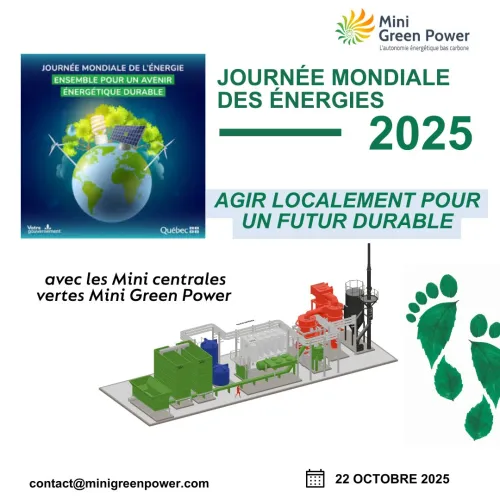
Every 22 October, World Energy Day reminds us of a simple imperative: without secure, affordable and sustainable energy, there can be no prosperity or resilience. This goal – UN SDG 7 – will not be achieved solely through large-scale national projects. It also plays out, very concretely, at the local level. This is where Mini Green Power comes in: transforming local green waste into heat, electricity and stored carbon, for energy that is closer to home, more circular and lower in carbon.
SDG 7 aims to achieve universal access to modern, reliable and affordable energy, while reducing its environmental footprint. However, many communities face a complex equation: price pressures, dependence on imports, network constraints and organic waste management. There is no single answer. It must combine sobriety, efficiency, renewables and solutions adapted to local contexts. Making use of under-utilised resources – such as green waste – is part of this realistic mix.
The approach is deliberately pragmatic. Mini Green Power designs mini green power plants sized for specific areas (industrial zones, communities of municipalities, agri-food sites, etc.). The logic: short supply distances, controlled flows, useful co-products. The resources used are green waste (prunings, cuttings, non-food agricultural residues) which would otherwise be of little value. Production is primarily aimed at useful heat (heating networks, processes), with the possibility of electricity when local demand justifies it. All of this is part of public-private partnerships, with clear operating and environmental monitoring plans.
"Our compass is local utility: human-scale solutions, interconnected with the real needs of the regions, and a measurable impact on emissions and energy bills." — Julien Florent, Managing Director
The core technology is based on controlled thermal recovery: pre-selected and prepared green waste feeds a high- -performance combustion chamber (staggered combustion, fine control of air and temperatures). The heat produced is used directly (hot water, steam, processes) or feeds a conversion module (e.g. ORC) to generate electricity where appropriate.
A key element is the production of biochar: a solid carbonaceous residue obtained under specific thermal conditions. Used in accordance with best practices, it stores carbon over the long term and can improve soil quality (water retention capacity, structure, microbial life). This "carbon" brick makes it possible to combine energy transition and measurable sequestration, in a circular economy approach: waste → useful energy → co-product with agronomic value.
Environment
• Emissions reduction: substitution of fossil fuels for heat and, in some cases, for electricity.
• Carbon sequestration: biochar permanently captures some of the carbon initially present in the biomass.
• Responsible waste management: less open-air burning, less landfill, traceability of flows.
Economy and industry
• More predictable energy costs: anchored in a local resource, less exposed to international price shocks.
• Site competitiveness: heat close to where it is needed, continuity of service, savings on waste treatment.
• New local jobs: collection, preparation of biomass, operation and maintenance, agronomic monitoring of biochar.
Territories
• Resilience: partial autonomy for essential thermal uses (processes, heating networks, public buildings).
• Acceptability: facilities of a manageable size, integrated into the landscape, designed to coexist with local activity.
• Short loops: a local resource becomes a lever for development (energy + soil), serving the climate.
The transition is not just about technology. It involves organising ecosystems where green waste producers, local authorities, manufacturers and citizens work together to develop pragmatic, measurable and replicable solutions. The challenge is not to pit sectors against each other, but to combine solutions: sobriety, efficiency, heating networks, local biomass, solar, wind, storage and soil management via biochar.
22 October is a symbolic milestone. The rest of the year will be spent working on the ground: mapping resources, calibrating needs, securing supply quality and measuring results (energy delivered, emissions avoided, carbon stored). It is this culture of evidence that will turn SDG 7 from a principle into reality.
Acting locally means making SDG 7 tangible: secure, affordable and sustainable energy based on what the region knows and masters. Mini biomass power plants and biochar are not a miracle solution, but a robust building block in the mix, immediately deployable and compatible with climate objectives. It is up to us, collectively, to make it an accelerator for transition – in the right place, for the right uses, with verified results.
October 22, 2025


 en
en 