
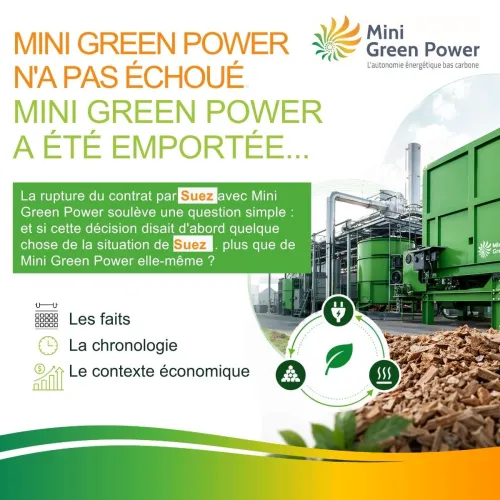
At first glance, the Mini Green Power case might be seen as just another commercial dispute. An innovative SME, a large corporation, a broken contract, unpaid invoices, followed by a sudden collapse. But as soon as one reconstructs the timeline, examines Suez’s financial situation in 2025 and places the contract termination within the context of the group’s ongoing restructuring, a different interpretation emerges. That of a promising industrial company that became collateral damage in defensive strategic manoeuvres beyond its control.
Some bankruptcies tell us more than just the story of a company’s downfall. They reveal something about an ecosystem, a balance of power, an era. The recent history of Mini Green Power falls into this category.
This Var-based SME, with 12 years of research and development, 38 patents and 25 employees, did not represent the failure of a technology. On the contrary, it embodied an industrial promise in the field of energy recovery from solid waste fuels. Its demonstration plant in Narbonne, a joint venture with Suez, had reached a stage of completion of around 90%. And yet, within a few weeks, the momentum came to a halt.
The question is therefore not merely whether Suez terminated a contract under unfavourable terms. It is to understand why this termination occurred at that precise moment, with such abruptness, and with such consequences for a far more vulnerable partner. In light of Suez’s 2025 accounts, the arrival of a new management team tasked with turning the company around, massive asset write-downs and a series of contractual or competitive tensions, the facts point to a broader interpretation: Mini Green Power appears less as the victim of an isolated disagreement than as a collateral victim of a rationalisation drive underway at Suez.
To understand the Mini Green Power case, one must first view Suez not merely as a client, but as a group that entered a phase of severe economic strain in 2025.
The figures published for the 2025 financial year paint a grim picture. The group’s net loss reached €671 million, compared with €211 million a year earlier. Net debt rose from €5.4 billion to €5.8 billion. EBITDA fell by 1.5% to €1.539 billion. Above all, asset write-downs skyrocketed: €512 million in 2025, compared with €27 million in 2024.
This single discrepancy speaks volumes. It signals a shift in scale in the way the group is revaluing its assets, contracts and prospects. Nathalie Pivet has, moreover, acknowledged that a comprehensive review of the balance sheet had been carried out and that €580 million in post-tax write-downs had been recorded. In other words, Suez was not simply facing a bad year. The group was entering a phase of comprehensive review, financial restructuring and strategic realignment.
This context matters. For when a major group sharply downgrades its accounts, it does not merely record its losses. It prioritises its objectives, tightens its commitments, and decides what to protect and what to abandon. At such a time, the most vulnerable projects are not always the least relevant in substance. They may simply be the least defensible in the short term within a recovery strategy.
The Vencorex case reinforces this interpretation. The liquidation of this industrial player in the spring of 2025 was explicitly linked by Suez and the press to the deterioration in 2025 results. Vencorex was a major client of the Suez RR IWS Chemicals France site in Pont-de-Claix, and its disappearance accounts for a significant portion of the €108 million in write-downs on tangible assets related to hazardous waste. This external shock automatically reduced the group’s room for manoeuvre.
Added to this is another, deeper legacy: that of the restructuring of the new Suez in 2022 following the split from Veolia. The 2025 accounts show €313 million in write-downs linked to changes in the portfolio of contracts acquired at that time. Here again, the signal is clear. Part of the inherited portfolio proved less favourable than anticipated. This weighs on the accounts, undermines profitability and fuels a more stringent approach to selecting commitments.
Taken together, these factors do not in themselves prove the direct cause of the termination of the contract with Mini Green Power. But they profoundly alter the interpretation of the case. They show that the decision was taken by a group under pressure, busy reviewing its asset base, its profitability and its commitments.
The timeline is decisive here.
In July 2024, Mini Green Power signed a construction contract with Suez for a 1 MWth industrial CSR demonstrator at the Écopôle Lambert in Narbonne. In October 2024, an exclusive commercial contract provides for the purchase of five 10 MWth mini-power plants, with projected revenue of €50 million, as well as the recovery of 110,000 tonnes of CSR over five years. The project is therefore by no means trivial. It combines an industrial demonstrator with a transformative commercial outlook.
During 2025, the demonstrator is delivered and approximately 90% complete. The project is therefore at a very advanced stage. Then comes autumn 2025, a pivotal moment for Suez.
On 1 July 2025, Xavier Girre, former Chief Financial Officer of EDF, takes over as CEO of the group. In the autumn, Nathalie Pivet, also formerly of EDF, joins the finance department. In October 2025, a transformation plan is presented to the Central Works Council, accompanied by GEPP negotiations and a voluntary redundancy scheme for support functions in France. This sequence marks the start of a cycle of recovery, rationalisation and reorganisation.
It is against this backdrop that Suez notified, on 14 November 2025, the termination of the Mini Green Power contract. It took effect on 22 November. The proximity of these dates is no mere coincidence. It places the termination within a much broader sequence than the mere lifespan of the Narbonne project.
The facts therefore suggest that the MGP case was dealt with at the very moment the group was scrutinising its commitments and risks. This does not allow us to assert, as things stand, that the contract was terminated solely for financial reasons. But the sequence of events strongly suggests that the decision was not taken in a strategic or financial vacuum. It occurred in the midst of a recovery phase.
Another factor reinforces this interpretation: the absence of any prior formal notice mentioned in the file. In a project at this advanced stage, such a rapid termination, taking effect just eight days later, is striking in its abruptness. Here again, caution is required in one’s choice of words. Yet the timeline points to a hasty decision regarding a commitment that had already largely materialised industrially.
It is here that the case becomes exemplary.
Mini Green Power was not an opportunistic entity built on a grant or a passing fad. The company possessed a solid technological foundation, intellectual property, substantial research depth and genuine industrial ambition. Twelve years of R&D. Thirty-eight patents. Twenty-five employees. A near-completed demonstrator. A partnership capable of opening up a much broader industrial market.
All this matters, because it shifts the perspective. The report does not describe a company swept away by the inadequacy of its project. It describes a company weakened by the abrupt interruption of a trajectory that depended on a dominant partner.
The figures presented later in the case file make the situation even more tangible. On 12 February 2026, Jean Riondel alerted Xavier Girre to a critical cash flow crisis and unpaid invoices totalling €560,000. On 3 April 2026, a claim for the merits of the case was brought before the Paris Commercial Court to secure immediate payment of the outstanding €650,500 and to claim €26 million in damages.
For a large group, this amount of outstanding debt may be just one dispute among many. For an SME with 25 employees, it can bring an entire organisation to its knees. It is precisely this imbalance that allows us to speak of collateral damage. Not because legal causality has already been established, but because the economic impact of a contractual dispute obviously carries different weight depending on the size of the parties involved.
The crux of the matter is this: Mini Green Power seemed to have been brought down less by any inherent weakness than by the squeeze effect caused by the termination of a key contract and the accumulation of unpaid debts. The industrial project remained viable. The company, however, was deprived of the time and resources needed to absorb the shock.
In other words, the case does not merely illustrate the vulnerability of an SME. It also illustrates how a decision taken as part of a turnaround strategy within a large group can lead to the bankruptcy of a smaller partner.
One of the risks, when dealing with a case such as this, would be to over-interpret it. We must therefore remain precise. No, Suez’s other setbacks do not in themselves prove that the Mini Green Power case is part of the same pattern. But they form a climate of tension that gives the case greater significance.
The group has recently experienced several significant setbacks or disputes. The award of the Aquavesc contract to Suez was overturned by the Versailles Administrative Court on 24 February 2026. Suez’s appeal in the SEDIF case was dismissed by the Council of State on 2 February 2024. The Hydreaulis contract was lost to Saur in September 2025. Other losses are reported for the Béziers urban area and for waste incineration in Montpellier, to Veolia and Urbaser.
To this must be added a particularly illuminating legal precedent in the field of commercial relations. On 26 February 2025, the Court of Cassation upheld the ruling against Suez Eau France to pay €115,707 in damages to a partner company for the abrupt termination of established commercial relations. This precedent obviously does not prejudge the outcome of the MGP case. But it shows that Suez has already been penalised in a similar context for commercial relationship management deemed to be at fault.
Taken in isolation, each of these elements relates to a separate case. Taken together, however, they paint a broader picture: that of a group in the process of repositioning itself, under pressure in the competitive arena, facing losses, litigation and increasingly sensitive arbitration cases.
Against this backdrop, the Mini Green Power affair no longer appears to be an incomprehensible accident. It looks more like one of the points of friction in a period where Suez is attempting to restore its economic trajectory, sometimes at the cost of difficult decisions for its partners.
It is perhaps here that the case becomes most striking.
The abandoned demonstrator project fell within the scope of renewable energy development, an activity presented as a growth driver in Suez’s 2026–2030 strategic plan. In other words, the Mini Green Power project was not on the fringes of the group’s stated strategy. On the contrary, it fell within an area that Suez claimed it wanted to develop.
The paradox is therefore striking. A project that was technologically consistent with the group’s public trajectory appears to have been abandoned at a time when, precisely, that trajectory was facing significant economic constraints. This discrepancy does not allow us to conclude that the project was fundamentally doomed. Rather, it suggests that it may have become expendable within a short-term mindset.
This is where the Mini Green Power case takes on an almost symbolic dimension. A young industrial company, capable of bringing innovation to energy recovery, finds itself weakened at the very moment when the major players claim they want to accelerate the transition and innovation. A demonstrator that is almost complete does not lead to a ramp-up. It is halted. An industrial promise does not lead to mass production. It becomes bogged down in litigation.
There is, in this sequence, an obvious industrial waste. And this waste goes far beyond mere contractual issues. It touches on the ability of an ecosystem to protect its innovators when major groups, for their part, adopt a strategy of retrenchment or recovery.
Mini Green Power then emerges as perhaps what it most accurately is: not a peripheral issue, but a very concrete indicator of the secondary effects of a financial crisis on the most exposed partners.
The Mini Green Power case is not merely a breach of contract. It highlights a broader sequence of events. A group weakened by its 2025 accounts. Massive write-downs. The Vencorex shock. A re-evaluated contract portfolio. A new management team brought in to restore profitability. A transformation plan in the autumn. Then, in this sequence, the abrupt termination of an industrial project that was nevertheless well advanced and consistent with the stated strategic direction.
Nothing in the available evidence allows this interpretation to be transformed into definitive legal truth. But everything in the chronology, the financial context and the concrete consequences for the SME leads one to view Mini Green Power as far more than an unfortunate co-contractor. The company is clearly yet another collateral victim of the recovery process underway at the level of a large group.
And that is undoubtedly the most important point. Behind the accounting figures and strategic decisions lies an industrial and human reality. Twenty-five jobs. Twelve years of research. Thirty-eight patents. A demonstrator nearing completion. Real technological potential. Mini Green Power is not merely a failed company. It also embodies what a strained economy may sacrifice when it treats innovation as an adjustment variable.
What this article demonstrates
• The termination of the MGP contract cannot be understood outside the financial context of Suez.
• The timeline for 2025 reinforces the idea of a decision made within a restructuring framework.
• Mini Green Power possesses genuine technological and industrial assets.
• The impact of the termination is potentially devastating for an SME with 25 employees.
• The MGP case is part of a broader context of tensions and setbacks at Suez.
• This case illustrates a potential industrial waste at the expense of a French cleantech company.
Sources
• Suez press release of 9 April 2026
• Suez SA consolidated accounts as at 31 December 2025
• Les Échos, 13 April 2026
• L’Usine Nouvelle, 10 April 2026, “Rising debt, liquidation of Vencorex: Suez triples its net loss to €671 million in 2025”
• Boursorama/AFP, 10 April 2026
• Le Journal des Entreprises, 7 April 2026, “Mini Green Power takes Suez to court to save 25 jobs”
• Presse Agence, 3 and 7 April 2026
• GreenUnivers, 17 March 2026
• La Marseillaise, 8 April 2026
• Franceinfo, 24 February 2026, Aquavesc case
• Council of State, decision no. 489820 of 2 February 2024, SEDIF
• Court of Cassation, Cass. com., 26 February 2025, no. 96 FS-B, appeal no. M 23-50.012, Transports M. case
• L’Informé, September 2025
• CGT Services Publics and CGT Suez Eau France, inter-union leaflets 2025–2026
• Pappers.fr, Mini Green Power profile, RCS Toulon 802 741 751
• Bodacc B No. 20250200, change of management at MGP
20 April 2024


 en
en 